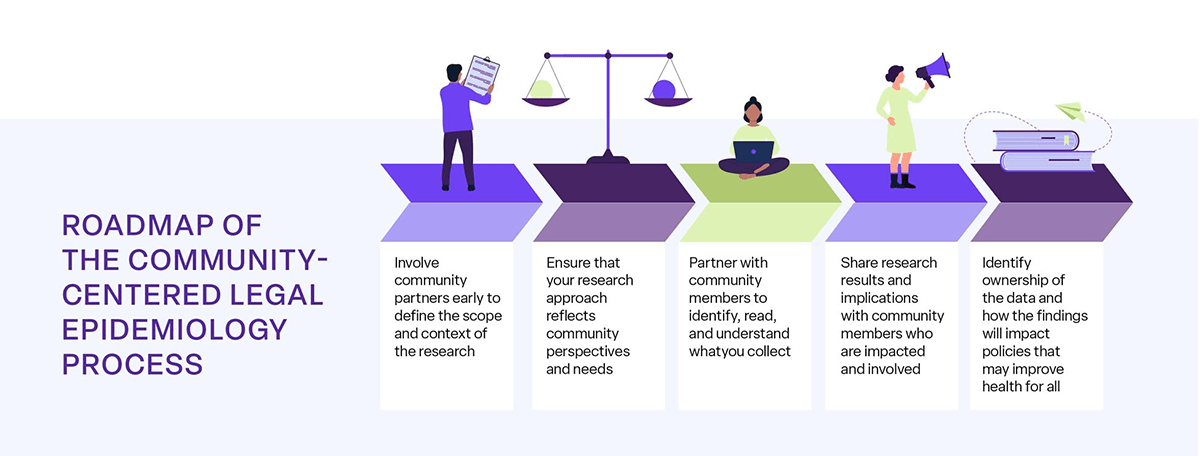
Public health aims to achieve optimal health for all. Yet, across the country, some communities consistently flourish while others consistently experience protracted and worsened health outcomes. This is in large part due to historic and still present laws and policies that act as facilitators or barriers for health and well-being.
Community-centered legal epidemiology provides a framework for bringing decision makers into authentic partnership with communities impacted by adverse outcomes. When legal epidemiology takes on a “Power-With” approach that both leverages the capacity of those with institutional influence and those most impacted by it, practitioners can deepen their analysis of barriers to health and build community capacity to address these challenges, thereby improving the effectiveness and fairness of public health laws and policies.
This guide is a companion to Moving Towards Community-Centered Legal Epidemiology: A Crosswalk of Frameworks (the Crosswalk). While the Crosswalk provides the “what” and “how,” this Guide offers the “why” and “so what.” When using this guide, you will be invited to consider how the laws you study and the process by which you study them can both reflect and reinforce policy barriers and may limit improving health for all when we do not authentically engage communities most impacted by those laws and policies. And, with intentional planning and collaborative design, community-centered legal epidemiology can be an impactful approach to promote health and wellbeing for all and address persistent differences in health outcomes.
This Practitioner Guide is designed to:
- Explain key concepts and provide additional framing for engaging and centering community throughout the legal epidemiology (legal epi) process.
- Bring the work to life by highlighting stories from the OMH Coordinating Center and grantees that illustrate successes, challenges, and lessons learned.
- Provide guided reflection and resources to help you pause, recalibrate, and align your approach to community engagement throughout the legal epi process.
- Engage partners, collaborators, and community members as you design and implement your legal epi process.
While we recommend using this guide during the start of designing your legal epi project, it is meant to be practical and flexible – a tool you can return to as you navigate each process step. You may not answer every question posed here, and that’s okay; the goal is to take what feels most relevant and to revisit the guide over time as your work evolves and new opportunities for reflection emerge.